Canvas Originals, by Number
Short readings, prompts and small activities written by J. R. Schwebach for his Biology classes. Each one appears here first under a permanent number, with the date it was published, and then goes into Canvas carrying that number. © J. R. Schwebach, licensed CC BY-NC 4.0.
Canvas Original #1 · Follow the Insulin
Published 29 September 2026 · Module 2 Cell Structure and Function, Lesson 2 · reading, about 130 words
How one protein, insulin, is built and shipped out of a pancreas cell, organelle by organelle.
After you eat, the sugar in your blood rises, and cells in your pancreas answer by releasing insulin, a protein. Making it takes a team of organelles. The instructions for insulin are stored in the DNA inside the nucleus. A copy of those instructions travels out to ribosomes, many of them attached to the rough endoplasmic reticulum. There the ribosomes link amino acids, the monomers of a protein, into a long chain. The ER carries the new protein through its tubes to the Golgi apparatus, which finishes it, sorts it and packs it into a vesicle. The vesicle travels to the cell membrane, opens to the outside, and releases the insulin into your blood.
Canvas Original #2 · More Alike Than Different?
Published 29 September 2026 · Module 2 Cell Structure and Function, Lesson 2 · claim, evidence, reasoning prompt
A claim–evidence–reasoning prompt built on students’ own count of twelve cell structures.
Are plant cells and animal cells more alike than different? Use your count from the organelle chart.
- Claim: one sentence that answers the question.
- Evidence: at least one number from your count — how many of the twelve structures each kind of cell has, and how many they share.
- Reasoning: why both kinds of cell need the structures they share, and what the structures only one of them has let it do.
Canvas Original #3 · The Cell as a School
Published 30 September 2026 · Module 2 Cell Structure and Function, Lesson 2 · analogy word bank, twelve places
Twelve places in a school, for matching each cell structure to a place that does the same kind of job.
Every structure in a cell has a job, and so does every place in a school. Match each structure on your organelle chart to the place whose job is most like it. Then finish the sentence: The ___ is like the ___ because both ___.
Word bank, A to Z: backpacks and delivery carts · boiler room · cafeteria kitchen · class-schedule office · custodians · fence · front doors · hallways · mailroom · main office · solar panels · walls and beams
Each place fits one structure best. If a place seems to fit two, pick one and let your “because” defend the choice.
Canvas Original #4 · The Grease Spot
Published 30 September 2026 · DE Biology, Unit 3 Carbon and the Molecules of Life, Day 6 · reading, about 300 words
Why fat leaves a lasting spot on brown paper, and how the same water-shy tails make butter solid, oil liquid and a cell membrane close on its own.
Rub a potato chip across a brown paper bag and hold the bag up to a window. The spot glows. Put a drop of water beside it and that spot glows too, for a few minutes, and then it dries and disappears. The grease stays. Fat does not evaporate at room temperature and does not mix with water, and Lab 2 uses that stubbornness as its test for lipids.
A fat is reluctant around water because of how it is built. A triglyceride is one glycerol holding three fatty acids, and each fatty acid is a long tail of carbon and hydrogen. Carbon and hydrogen share their electrons almost evenly, so the tails carry no charge for water to grab. Water molecules hold on to one another instead and crowd the tails together. If every bond in a tail is single, the tail runs straight, and straight tails stack like pencils in a box, which is why butter sits solid on the counter. One double bond locks a kink into the tail, kinked tails cannot stack, and olive oil pours.
Swap one of the three tails for a phosphate group and the molecule changes character. The phosphate end carries a charge and turns toward the water; the two remaining tails still hide from it. Drop a crowd of these phospholipids into water and they arrange themselves into two sheets, tails inward and heads outward, with nothing directing them. That bilayer is the edge of every cell in your body. Cholesterol, a steroid with four linked rings instead of tails, tucks in between the phospholipids and keeps the sheet from turning too loose or too stiff.
The brown paper will tell you a food holds fat. It will not tell you whether the tails are straight or kinked, because butter and olive oil leave the same spot.
Canvas Original #5 · Lipid and Nucleic Acid Word Cards
Published 30 September 2026 · DE Biology, Unit 3 Carbon and the Molecules of Life, Day 6 · cut-out card set, twenty words and twenty meanings, with a small-group routine
Twenty word cards and twenty meaning cards for lipids and nucleic acids, played in three rounds: match, sort, connect.
- Match. Lay the meanings face up. Stack the words face down. Take turns turning over a word and reading it aloud; the group agrees on its meaning before anyone picks it up.
- Sort. Split the matched pairs into two piles, lipids and nucleic acids. Then find the two cards that name the same kind of bond-making reaction in two different molecules.
- Connect. Each person draws two word cards and says one sentence that joins them. The group checks the sentence against the meanings.
The twenty cards:
- lipid — A large biological molecule grouped by one property rather than one structure: it mixes poorly with water. Fats, phospholipids and steroids. Not a polymer.
- hydrophobic — “Water-fearing.” Built mostly of C–H bonds, so it carries no charge for water to grab and does not dissolve in water.
- triglyceride — A fat: one glycerol joined to three fatty acids. Stores about twice the energy per gram that a carbohydrate does.
- glycerol — A three-carbon alcohol with a hydroxyl group on each carbon. The backbone a fat’s tails attach to.
- fatty acid — A long hydrocarbon chain, usually 16 to 18 carbons, with a carboxyl group at one end.
- ester linkage — The bond between a hydroxyl of glycerol and the carboxyl of a fatty acid, made by dehydration. A fat has three.
- saturated fatty acid — No carbon–carbon double bonds. Straight tails pack tightly, so the fat is solid at room temperature, like butter.
- unsaturated fatty acid — One or more cis double bonds, each putting a kink in the tail. Kinked tails cannot pack, so the fat is liquid, like olive oil.
- phospholipid — Glycerol joined to two fatty acids and a phosphate group. The phosphate end is a hydrophilic head; the two tails are hydrophobic.
- amphipathic — Having a hydrophilic region and a hydrophobic region in the same molecule.
- phospholipid bilayer — Two sheets of phospholipids, heads facing water on both sides and tails hidden inside. Forms on its own; the basis of every cell membrane.
- steroid — A lipid built from four fused carbon rings. Cholesterol is one; it sits in animal cell membranes and is the starting point for sex hormones.
- nucleotide — The monomer of a nucleic acid: a phosphate group, a five-carbon sugar and a nitrogen-containing base.
- nitrogenous base — The nitrogen-containing ring of a nucleotide: A, G, C and T in DNA; A, G, C and U in RNA. Their order is the information.
- deoxyribose — The five-carbon sugar in DNA. It is missing the oxygen at carbon 2′ that the sugar in RNA carries.
- ribose — The five-carbon sugar in RNA, with a hydroxyl group on carbon 2′.
- phosphodiester linkage — The covalent bond joining the phosphate of one nucleotide to the sugar of the next. A chain of them is the sugar–phosphate backbone.
- complementary base pairing — A pairs with T (U in RNA) and G pairs with C, held by hydrogen bonds. Know one strand and you can write the other.
- antiparallel — The two strands of DNA run in opposite directions: one 5′ to 3′, the other 3′ to 5′.
- double helix — The shape of DNA: two strands wound around one axis, sugar–phosphate backbones outside, paired bases inside.
Canvas Original #6 · SAM Prompts for Lipids and Nucleic Acids
Published 30 September 2026 · DE Biology, Unit 3 Carbon and the Molecules of Life, SAM Builder · twelve student-authored-module prompts and four checks
Four checks for a strong student-authored question, and twelve prompts for writing one on lipids and on nucleic acids.
A SAM is a question you write at the spot where your understanding broke, answered in your own drawing and your own words. Four checks make one strong:
- It asks why or how, not only what.
- The answer includes a drawing you made, labeled.
- One sentence names the mechanism: what the atoms or molecules are doing.
- It names a tempting wrong answer and says why it fails.
Lipids
- L1. Why is a fat not a polymer? Draw glycerol and three fatty acids joining, circle the three ester linkages, and count the waters released.
- L2. What makes butter solid and olive oil liquid? Draw six straight tails stacked and six kinked tails failing to stack, and mark the double bond that makes each kink.
- L3. Why does a crowd of phospholipids form a bilayer in water without anything directing it? Draw the bilayer, label heads, tails and where the water is.
- L4. A fat and a phospholipid both start from glycerol. What changes when one fatty acid is swapped for a phosphate group, and what can the new molecule do that a fat cannot?
- L5. Cholesterol has four rings and almost no oxygen. Why is it a lipid when it looks nothing like a fat, and where in a cell do you find it?
- L6. Why does a fat leave a spot on brown paper while water’s spot disappears, and what can that test not tell you about the fat?
Nucleic acids
- N1. Take one nucleotide apart. Draw the three parts and number the sugar’s carbons 1′ to 5′.
- N2. Name two differences between the parts of RNA and DNA, and one difference in their shape.
- N3. A sample of DNA is 30% adenine. What are the percentages of T, G and C? Show the pairing that lets you know.
- N4. Write the strand that pairs with 5′-ATGCCGTA-3′, with both of its ends labeled.
- N5. Draw three nucleotides joined into a strand. Circle each phosphodiester linkage and show where the water went when it formed.
- N6. Phosphate turns up in a phospholipid and in a nucleotide. What does its charge do in each one?
Canvas Original #7 · Do Plant Cells Need Mitochondria?
Published 30 September 2026 · Module 2 Cell Structure and Function, Lesson 3 · claim, evidence, reasoning prompt
A claim–evidence–reasoning prompt built on students’ own Plants and Snails data: the gas a plant gives off in the light and in the dark.
A plant builds its own sugar from light, water and carbon dioxide. Does a plant cell still need mitochondria? Answer from your Plants and Snails data.
- Claim: one sentence that answers the question.
- Evidence: the two Plant Only tubes, lights on and lights off. For each one, give the color of the water and the carbon dioxide reading after 24 hours.
- Reasoning: what a mitochondrion does with sugar and oxygen, and how that explains the gas the plant gave off in the dark.
Going further: in the light, the plant’s mitochondria keep working, yet its tube turns blue. Explain why.
Canvas Original #8 · What Turns Lake Anna Green (Biology #15)
Published 1 October 2026 · Module 2 Cell Structure and Function, Lesson 3 · CER one-pager with its own page, plus the talk prompts used with it
Cyanobacteria in Lake Anna as a prokaryote that photosynthesizes without a chloroplast, set against an Elodea leaf cell; reading, data table and five claim–evidence–reasoning items.
Full page: Biology #15 · What Turns Lake Anna Green: A Prokaryote That Photosynthesizes.
Talk prompts used with it in class. Claim-pass: Partner A states a claim and one piece of evidence, using two words from the vocabulary box. Partner B restates the claim in different words and adds the reasoning. Then switch. Bridge question: A Microcystis colony holds thousands of cells. Is it a multicellular organism? Each pair then writes one question at the exact spot where their understanding broke.
Canvas Original #9 · Seaweed Under the Microscope
Published 1 October 2026 · Module 2 Cell Structure and Function, Lesson 3 · reading, about 200 words, with observation questions
Dried nori on a slide as a eukaryotic, multicellular alga that is not a plant: what students are seeing at low power, and why its classification is still argued.
The seaweed on the slide is nori, the dark sheet wrapped around sushi. It is made from Pyropia, a red alga that grows on rocks along cold, shallow coasts, chopped up and dried into thin sheets. A living Pyropia blade is only one cell thick, which is why light passes through it and you can see separate cells at low power without cutting or staining anything.
Nori is a eukaryote all the way through. Each cell in the living blade had a nucleus, mitochondria and a chloroplast, and each is boxed in by a cell wall. The chloroplast holds green chlorophyll and a red pigment, phycoerythrin, and together they make the dry sheet look nearly black. Nori is also multicellular: a blade grows from a single spore, and its cells stay attached as one organism.
So is it a plant? Not in the classification most biology courses use. Algae such as nori are placed with the protists, the kingdom for eukaryotes that are not plants, animals or fungi. Scientists still argue about where the lines belong. Red algae share an ancestor with green algae and land plants, and their chloroplasts are thought to descend from a cyanobacterium, a relative of the cells that turn Lake Anna green.
At low power, the 4x objective
- Find a thin edge of the sheet. What shapes do you see packed together, and what tells you each one is a separate cell?
- Count the cells across one row, as many as you can follow. Write the number and compare it with your partner’s.
- Is nori unicellular or multicellular? A Microcystis colony is also thousands of cells. What makes a nori blade one organism and the colony many?
- Lake Anna’s green and nori are both called algae. Name one structure nori’s cells have that Microcystis cells lack.
Then the 10x objective, and no higher: switch to the 10x objective and refocus with the fine-focus knob. If you can make out a darker blotch inside a cell, which organelle is it most likely to be, and why? (Revised 1 October 2026: students stop at the 10x objective until they have more microscope training.)
To keep thinking about: nori makes its own food and has cell walls and chloroplasts, yet it is not classified as a plant. What would a living thing need before you would call it a plant?
Canvas Original #10 · Water Sticks Because Oxygen Pulls Harder
Published 2 October 2026 · Module 1 Biochemistry, Remediations (LT 1.1 Properties of Water) · guided reading, about 500 words, with a nine-question practice check
A short reading on why water is polar and what a hydrogen bond is, sending students through four steps of The Water Patch (Bio Tool #10) aimed at the errors on the Module 1 test, followed by a self-checking practice set.
A water molecule is one oxygen atom holding two hydrogen atoms in a bent V. Each hydrogen shares a pair of electrons with the oxygen, and the sharing is lopsided. Oxygen pulls harder, so the electrons spend more of their time near it. The oxygen end becomes slightly negative (δ−) and each hydrogen end slightly positive (δ+). The bonds inside the molecule are polar covalent bonds. No electron changes hands for good, so water is polar, not ionic.
Set two water molecules side by side and the δ+ hydrogen of one is drawn to the δ− oxygen of the other. That pull between two separate molecules is a hydrogen bond. It is far weaker than the covalent bonds inside each molecule, so hydrogen bonds break and re-form all the time while every molecule stays whole. Nearly everything unusual about water, from floating ice to its grip on glass, traces back to this one pull.
In the Water Patch. Open the Water Patch in a new tab. Tap iPad, then 9th Grade SOL Bio, and stay in Module 1 · Water & Phases. Do only Steps 1, 2, 4 and 5; tap a step number to jump to it. Answer each step’s prediction question before you play. About 20 minutes.
- Step 1 · The hydrogen bond. Do: Drag molecules together until you have made three hydrogen bonds. Watch for: Which end turns to face the neighbor before it docks. Solid sticks are covalent bonds inside a molecule; the dashed line is a hydrogen bond between molecules. Say it: “Oxygen pulls the electrons harder, so O is δ− and H is δ+. A hydrogen bond links a δ+ H on one molecule to a δ− O on another.”
- Step 2 · Heat and cold. Do: Freeze the water, then boil it. Watch for: Boiling breaks the dashed lines, never the solid sticks. Frozen, the lattice holds the molecules farther apart than in the liquid. Say it: “Boiling breaks hydrogen bonds, not water molecules. Ice is less dense than liquid water, so it floats.”
- Step 4 · Flow and freezing. Do: Leave the water still and let it freeze. Press Flow only if you have time. Watch for: Where the first ice forms, and which direction it grows. Say it: “Ice forms on top and floats, so it works like a lid, and the water under it stays liquid.”
- Step 5 · Salt dissolves. Do: Drop an NaCl crystal. You can skip the second compound. Watch for: Which end of each water molecule turns toward Na⁺ and which turns toward Cl⁻. Say it: “Salt is ionic; water is polar. Water’s δ− and δ+ ends pull the ions loose, which is why water dissolves so many substances.”
The sticky properties come from the same bond. Cohesion is water attracted to water. Adhesion is water attracted to another polar surface, such as glass, paper or the walls of a plant’s tubes. Surface tension is cohesion at the surface: hydrogen bonds pull each surface molecule toward its neighbors, so the surface holds together like a stretched sheet. Capillary action is the two working together in a narrow space: water clings to the walls and drags more water up behind it. A complete explanation names the property, then says what the hydrogen bonds are doing.
Practice check. Nine questions, as many tries as you like, nothing in the gradebook. A wrong answer names the step to go back to.
- In a hydrogen gas molecule (H–H), the two atoms share their electrons evenly. In a water molecule (H–O–H), they do not. Which statement explains the difference?
- Hydrogen pulls on electrons harder than oxygen, so in water the electrons crowd around the hydrogens.
- Water is held together by ionic bonds, and hydrogen gas is not.
- Both molecules share electrons evenly; water simply has more atoms.
- Oxygen pulls on shared electrons harder than hydrogen does, so in water the electrons spend more time near the oxygen.
- In Step 1 of the Water Patch, a molecule swings around before it docks with its neighbor. What is it lining up, and why?
- Its oxygen with the neighbor's oxygen, because matching atoms attract
- Its hydrogen with the neighbor's hydrogen, so the two can share electrons
- One of its δ+ hydrogens with the neighbor's δ− oxygen, because opposite charges attract
- Its oxygen with one of its own hydrogens, to form a new covalent bond
- A pot of water boils. The steam rising from it is still H₂O. Which bonds broke as the water turned to steam?
- The covalent bonds inside each molecule, splitting water into hydrogen and oxygen
- Ionic bonds between oxygen ions and hydrogen ions
- No bonds broke; heat makes each molecule larger
- The hydrogen bonds between neighboring molecules; each molecule stayed whole
- The Water Patch draws two kinds of lines: a solid stick joining each H to its O, and a dashed line that appears between molecules. What does each one stand for?
- Solid stick: hydrogen bond. Dashed line: covalent bond.
- Solid stick: ionic bond. Dashed line: hydrogen bond.
- Solid stick: polar covalent bond inside one molecule. Dashed line: hydrogen bond between two molecules.
- Both lines are hydrogen bonds of different strengths.
- A plastic water bottle filled to the very top is left in a freezer overnight. In the morning its sides bulge outward. What does this show about water?
- Water shrinks as it freezes and pulls the sides of the bottle out of shape
- The same water takes up more space as ice, so ice is less dense than liquid water
- Freezing adds new water molecules from the air inside the freezer
- Ice is denser than liquid water, so it presses harder on the bottle
- On a January morning, a farmer finds a sheet of ice across the top of a cattle water tank. Under the ice, the water is still liquid. Which explanation is best?
- The ice formed at the bottom of the tank first, then rose to the top as it warmed
- Water under a layer of ice is too dense to ever freeze
- Ice is less dense, so it floats on top, and that layer slows the loss of heat from the water underneath
- Ice is denser than water, so it presses the cold water down and keeps it from freezing
- A spoonful of table salt disappears into a glass of water. Which explanation matches what you watched in Step 5?
- Water is an ionic compound, so it trades ions with the salt
- The salt melts because the water is warmer than the salt
- Salt is nonpolar, and nonpolar substances dissolve best in water
- Water molecules are polar, so their δ− and δ+ ends pull the salt's ions loose and surround them
- You can fill a cup slightly above its rim, and the water bulges up without spilling. Which is the most complete explanation?
- Cohesion: hydrogen bonds pull each surface molecule toward its neighbors, so the surface holds together like a stretched sheet
- Cohesion.
- Adhesion: the water sticks to the air above the cup
- Density: the water at the top is lighter, so it floats above the rim
- Match each everyday example with the property of water it shows best. One property is not used. Choices: Cohesion, Adhesion, Surface tension, Capillary action, Density.
- Two drops of water on wax paper touch and instantly merge into one drop.
- Drops of water cling to the inside wall of a drinking glass after it is emptied.
- Drops added one at a time to a coin pile up into a dome above its edge.
- A sugar cube touched to a cup of tea soaks the tea up from the bottom to the top.
Canvas Original #11 · A Tour of the Cell Word Cards
Published 2 October 2026 · DE Biology, Unit 4 A Tour of the Cell, unit opener · cut-out card set, twenty-four words and twenty-four meanings
Twenty-four word cards and their meanings for Chapter 4: prokaryotic and eukaryotic cells, the nucleus and ribosomes, the endomembrane system, mitochondria and chloroplasts, and the cytoskeleton and what lies outside the cell.
Played at tables of three or four, one deck per table, in short timed rounds: match each word to its meaning, sort the pairs into piles and name each pile, say a word without saying it, and join two words in one true sentence.
The twenty-four cards:
- prokaryotic cell — A cell with no nucleus and no membrane-enclosed organelles; its DNA sits in a nucleoid. Bacteria and archaea.
- eukaryotic cell — A cell with a nucleus and membrane-enclosed organelles: protists, fungi, plants and animals. Usually ten or more times wider than a bacterium.
- nucleoid — The region of a prokaryotic cell where its DNA is concentrated, with no membrane around it.
- surface-to-volume ratio — As a cell grows, its volume rises faster than its surface area. Too little membrane for the volume limits exchange, which keeps cells small.
- plasma membrane — The phospholipid bilayer, with proteins in it, that encloses every cell and controls what enters and leaves.
- nucleus — Holds most of a eukaryotic cell’s DNA and directs the cell by controlling which proteins are made.
- nuclear envelope — The double membrane around the nucleus, crossed by pores that let mRNA and ribosome parts out and proteins in.
- nucleolus — A dense spot inside the nucleus where ribosomal RNA is made and ribosome subunits are put together.
- chromatin — DNA wound around proteins. Spread out in a cell that is not dividing; packed into visible chromosomes when it divides.
- ribosome — rRNA and protein, with no membrane. Builds proteins: free ones for the cytosol, bound ones on the ER for membranes or export. Prokaryotes have them too.
- endomembrane system — Membranes that work as one shipping network by passing vesicles: nuclear envelope, ER, Golgi, lysosomes, vacuoles and plasma membrane.
- rough ER — ER studded with ribosomes. Makes proteins for membranes and for export, folds them, and ships them in vesicles to the Golgi.
- smooth ER — ER with no ribosomes. Makes lipids, including steroids; breaks down drugs in liver cells; stores calcium in muscle.
- Golgi apparatus — Stacks of flattened sacs that receive vesicles from the ER, modify and sort what they carry, and ship it out in new vesicles.
- lysosome — A membrane sac of digestive enzymes in an animal cell. Breaks down food, worn-out organelles and engulfed bacteria.
- central vacuole — A large sac in a mature plant cell that stores water, ions and wastes, and presses outward to keep the cell firm.
- mitochondrion — Site of cellular respiration: uses oxygen to release the energy in sugar and fat as ATP. Two membranes; the inner one folds into cristae. Plants have them too.
- chloroplast — Site of photosynthesis in plants and algae: captures light energy to make sugar. Two membranes around stacks of thylakoids.
- endosymbiont theory — Mitochondria and chloroplasts began as prokaryotes taken in by an ancestral cell. Evidence: two membranes, and their own DNA and ribosomes.
- cytoskeleton — A network of protein fibers through the cytoplasm that holds the cell’s shape, anchors organelles and moves things around.
- microtubule — The thickest cytoskeleton fiber: a hollow tube of tubulin. Tracks for vesicles; pulls chromosomes apart; builds cilia and flagella.
- microfilament — The thinnest cytoskeleton fiber: twisted chains of actin. Bears tension and changes cell shape; with myosin, it contracts muscle.
- cell wall — A rigid layer outside the plasma membrane of plants (cellulose), fungi and most prokaryotes. Protects the cell and holds its shape.
- extracellular matrix — The mesh outside an animal cell, mostly glycoproteins such as collagen. Supports cells and passes signals to them.
Canvas Original #12 · Carbon, Functional Groups, Carbohydrates and Proteins Word Cards
Published 2 October 2026 · DE Biology, Unit 3 Carbon and the Molecules of Life, Unit 3 close · cut-out card set, twenty-four words and twenty-four meanings
Twenty-four word cards and their meanings for the rest of Chapter 3: isomers, the seven functional groups, how polymers are built and broken, carbohydrates, and the four levels of protein structure.
Played at tables of three or four, one deck per table, in short timed rounds: match each word to its meaning, sort the pairs into piles and name each pile, say a word without saying it, and join two words in one true sentence.
The twenty-four cards:
- isomer — Compounds with the same molecular formula but different structures, and so different properties. Glucose and fructose are both C6H12O6.
- enantiomer — Isomers that are mirror images of each other, built around an asymmetric carbon, like a left and a right hand. Often only one of the pair works in the body.
- hydroxyl group — –OH. Polar, so it helps a molecule dissolve in water. It marks an alcohol, and every sugar carries several.
- carbonyl group — C=O. At the end of a carbon skeleton it makes an aldehyde; inside the skeleton, a ketone. Sugars are sorted by which one they carry.
- carboxyl group — –COOH. Acidic: it gives up H+ and becomes –COO−. Every amino acid and every fatty acid has one.
- amino group — –NH2. Acts as a base, picking up H+ to become –NH3+. Every amino acid has one.
- sulfhydryl group — –SH. Two of them, on two cysteines, can join into a disulfide bridge that holds a protein in its shape.
- phosphate group — –OPO32−. Carries negative charge. Links nucleotides, gives a phospholipid its head, and ATP carries a chain of three.
- methyl group — –CH3. Nonpolar. Added to DNA, it changes which genes are expressed; on a hormone, it changes the shape and the effect.
- dehydration reaction — Two monomers join by a covalent bond as a water molecule is released: one gives up –OH, the other –H. Every polymer is built this way.
- hydrolysis — Water is added to break the bond between two monomers, the reverse of a dehydration reaction. Digestion takes polymers apart this way.
- glycosidic linkage — The covalent bond between two sugars, made by a dehydration reaction. Whether it points α or β decides starch or cellulose.
- peptide bond — The covalent bond between the carboxyl group of one amino acid and the amino group of the next, made by a dehydration reaction.
- monosaccharide — A simple sugar, the monomer of carbohydrates, with a formula that is a multiple of CH2O. Glucose, fructose and galactose.
- disaccharide — Two monosaccharides joined by a glycosidic linkage. Sucrose is glucose + fructose; lactose is glucose + galactose.
- starch — A plant’s storage polysaccharide: chains of α-glucose, mostly coiled. Iodine turns it blue-black.
- glycogen — An animal’s storage polysaccharide: α-glucose, heavily branched, kept in liver and muscle cells.
- cellulose — The polysaccharide of plant cell walls: straight chains of β-glucose that hydrogen-bond into tough fibers. Humans cannot digest it.
- amino acid — The monomer of proteins: a central carbon holding an amino group, a carboxyl group, a hydrogen and an R group, the side chain. Twenty kinds.
- primary structure — The sequence of amino acids in a polypeptide, set by a gene. Change one amino acid and the whole shape can change, as in sickle-cell hemoglobin.
- secondary structure — Coils (α helix) and folds (β pleated sheet) held by hydrogen bonds between atoms of the backbone, not the side chains.
- tertiary structure — The overall 3-D shape of one polypeptide, set by its side chains: hydrophobic clustering, ionic bonds, hydrogen bonds and disulfide bridges.
- quaternary structure — Two or more polypeptides fitted together into one working protein. Hemoglobin is four.
- denaturation — A protein unfolds and stops working when heat, pH or salt break the bonds that hold its shape. The amino acid sequence stays intact.
Canvas Original #13 · Four Groups in One Egg, and Five Bridges Back to Macromolecules
Published 2 October 2026 · Module 1 Biochemistry, Remediations (LT 1.2 Macromolecules) · reading, about 170 words, five tool bridges and a thirteen-question practice check
An egg in a skillet as one place to see protein, lipid, carbohydrate and nucleic acid together, then five short bridges into the site’s tools aimed at the errors on the Module 1 test, followed by a self-checking practice set.
Crack an egg into a hot skillet and you are looking at all four macromolecule groups at once. Besides water, the clear white is almost all protein, long chains of amino acids folded into shapes. Heat unfolds those shapes (it denatures them), and the white turns solid and opaque. The yolk carries most of the egg’s fat, lipids stored as energy for a chick that would grow there. A little carbohydrate rides along too, as short sugar chains hooked onto several of the white’s proteins. On top of the yolk sits a pale spot a few millimeters across, the germinal disc, where the hen’s DNA is kept; that is the nucleic acid. The protein, the sugar chains and the DNA are polymers, long chains built from small monomers. The hen’s cells joined those monomers by pulling one water molecule out at each link, and fats are assembled the same way. Your digestive system runs the work in reverse: it puts a water molecule back at each link and splits the chains apart.
The five bridges. Each opens a tool in a new tab. Do the one thing asked, answer the question before moving on, then say the sentence out loud. About 25 minutes in all.
- Bridge 1 · A monomer is one bead; the polymer is the whole string. Open Bio Tool #6: Four Classes, One Membrane. Do: Keep the level switch on 9th grade. Tap Pump, then scroll down to the DNA strip under the membrane. Ask yourself: The pump is a polymer. What are its beads? DNA is a polymer too. What are its beads, and why can a strand of DNA never be the bead? Say it: “A monomer is one small unit; a polymer is the chain. Amino acids build proteins, and nucleotides build nucleic acids such as DNA. DNA is the chain, never the bead.”
- Bridge 2 · The word ending tells you the group. Open Bio Tool #8: SOL Challenge, Question 7. Do: Answer Question 7, then read the explanation under it. Ask yourself: Without notes, sort these into groups: glucose, cellulose, sucrose, glycerol, amino acid. Which three end in -ose, and which group do they belong to? Where do the other two go? Say it: “A word ending in -ose names a sugar, and sugars are carbohydrates. Glycerol ends in -ol and is part of a lipid.”
- Bridge 3 · Carbon bonds with hydrogen, oxygen and nitrogen, not only with carbon. Open Chem Tool #1: Bond Budget. Do: Build methane, then ethane, then ethanol. Tap one atom, then another, to bond them. Ask yourself: In ethanol, pick one carbon and count its bonds. How many, and to which atoms? Which of the three molecules has no carbon–carbon bond at all? Say it: “Carbon bonds with hydrogen, oxygen and nitrogen as well as with other carbons, and carbon chains can run straight or close into rings.”
- Bridge 4 · One membrane puts all four groups to work. Open Bio Tool #6: Four Classes, One Membrane. Do: Tap each class chip in turn: Lipid, Protein, Carbohydrate, Nucleic acid. Watch what lights up. Ask yourself: Which group makes the sheet, which does the work, which wears the name tags, and which wrote the instructions? Then: the wall of a plant cell is which group, and the fat that keeps a seal warm is which? Say it: “Lipids make the sheet and insulate. Proteins do the work. Carbohydrates give quick energy, label the cell and build plant cell walls. Nucleic acids hold the instructions.”
- Bridge 5 · Water out builds a chain; water in breaks it. Open Bio Tool #10: The Water Patch. Do: Tap iPad, then 9th Grade SOL Bio, then 2 · Enzyme Activity at the top, and watch the enzyme split its substrate. Ask yourself: Where did the water molecule go when the bond broke? Name that process. Now picture two amino acids joining at a ribosome: what leaves, and what is that process called? Say it: “Hydrolysis puts water in to split a chain. Dehydration synthesis takes water out to build one.”
Practice check. Thirteen questions, as many tries as you like, nothing in the gradebook. A wrong answer names the bridge to go back to.
- A freight train is a model of a macromolecule. Which part of the model stands for one monomer?
- one boxcar
- the whole train
- the coupling that joins two boxcars
- the rail yard where many trains wait
- Which one of these is a POLYMER?
- a single nucleotide
- one glucose molecule
- a strand of DNA
- a single amino acid
- A student extracts DNA from strawberries. If that DNA were cut apart into its monomers, what would be left?
- fatty acids
- simple sugars
- nucleotides
- amino acids
- A sports drink label lists dextrose as an ingredient. Judging by the word ending, dextrose is most likely –
- part of a lipid, like glycerol
- an amino acid, which builds proteins
- a nucleotide, which builds DNA
- a sugar, which is a carbohydrate monomer
- In methane (CH₄), one carbon atom is bonded to four hydrogen atoms. What does methane show about carbon?
- Carbon needs another carbon before it can make any bond.
- Carbon forms one bond at a time.
- Carbon appears only in fats.
- Carbon can bond with elements other than carbon.
- Glucose has six carbon atoms, five of them in a closed ring. Fats have long, straight chains of carbon. Which TWO statements do these molecules support? (Choose 2.)
- Rings of carbon appear only in proteins.
- Carbon atoms can join into straight chains and also close into rings.
- A molecule with more carbon in it is always a lipid.
- Carbon bonds to oxygen and hydrogen as well as to other carbon atoms.
- Match each example to the macromolecule group it depends on. Use each group once. Choices: Carbohydrate, Lipid, Protein, Nucleic acid.
- Cotton and wood get their strength from it.
- A walrus’s blubber keeps it warm in icy water.
- Spider silk and your fingernails are built mostly from it.
- A test that tells which bull sired a calf reads it.
- Hay stores energy in its carbohydrates, and a hog stores energy in its fat. Which statement is correct?
- Only carbohydrates build plant cell walls, and both groups can store energy.
- Only lipids build plant cell walls, and both groups insulate.
- Carbohydrates insulate, and lipids build plant cell walls.
- Neither group stores energy; only proteins do.
- Chew a saltine cracker for a minute and it starts to taste sweet. An enzyme in your saliva is splitting starch into sugars, and one water molecule is used at every split. This process is –
- dehydration synthesis
- evaporation
- hydrolysis
- denaturing
- At a ribosome, two amino acids are joined, and a molecule of water is released. Which describes what happened?
- hydrolysis, which split a protein into pieces
- hydrolysis, which made a longer chain
- dehydration synthesis, which split a protein into pieces
- dehydration synthesis, which made a longer chain
- The phospholipids that make the membrane sheet each have two long tails made of fatty acids, and those tails avoid water. A phospholipid belongs with –
- the proteins, because it has a head and two tails
- the lipids, because its tails are fatty acids that avoid water
- the carbohydrates, because it faces the outside of the cell
- the nucleic acids, because it carries a phosphate
- In the membrane tools, the pump runs on ATP. ATP has a base, a five-carbon sugar and phosphate groups. ATP is built like the monomers of which group?
- lipids, because part of it avoids water
- proteins, because it helps a pump do work
- nucleic acids, because it has a base, a five-carbon sugar and phosphate
- carbohydrates, because it contains a sugar
- Meat tenderizer powder contains papain, an enzyme from papaya that breaks down meat. Papain itself is built from –
- amino acids, because enzymes are proteins
- fatty acids, because it comes from fruit oil
- simple sugars, because papaya is sweet
- nucleotides, because it carries instructions
Canvas Original #14 · How We Play: Class Games and Talk Methods
Published 3 October 2026 · DE Biology, Module 0A, all year · student display page, twelve games in four families, with table jobs
Twelve classroom games and talk routines, each with steps, a score and a talk rule, written so the page on every iPad matches the one on the projector.
You remember what you have explained out loud far better than what you have only read. Every game here makes you explain a term or an answer to someone else, commit to it, and hear where it breaks. The points are practice and reset every day. Table jobs, rotated every round: Reader, reads cards and questions aloud; Checker, settles disputes from the meaning card or the key; Timer, runs the clock; the last person to answer takes this job next; Scorekeeper, keeps the tally and bands the deck at the bell; Questioner, asks, never answers.
Talk it out. Every student explains out loud, more than once.
- Ask Me Mine — Bring one SAM question you wrote. Ask your partner your question. Listen to the whole answer before you say anything. Tell them one thing they got right and one thing to add. Then switch: they ask, you explain. On the signal, one row moves down a seat. Three rounds. Score: No points. You explain three times in ten minutes. Talk rule: The author asks and the partner explains. Don't answer your own question until your partner has tried.
- The Questioner Card — One person at each bench holds the Questioner card. The Questioner may only ask the questions on the card: Why? How do you know? Which result surprised you? What would change your mind? Everyone else answers with evidence: a number from your data, a line from your notes, a drawing. Pass the card to the left at the next round. Score: No points. Talk rule: The Questioner never gives an answer, only the next question.
- Defend the Wrong Answer — You get a slip with one letter, A to D. Keep it face down. Read the question, then build the best case you can for your letter, even if you think it is wrong. Your group hears all four cases, then votes. After the key is revealed, the person holding the right letter says why each of the other three tempts people and fails. Score: No points. You come away able to say why each wrong answer looks right. Talk rule: Argue against the answer, never against the person.
Bet and play. Teams commit to an answer, then defend it.
- Wager Round — One iPad per team opens the Wager card. Talk for 60 seconds, pick A to D, bet 1, 2 or 3, and lock it in. Cards up when called. Before the reveal, one seat number is called on a team that bet 3. That person explains the answer. If the called seat can't explain it, the team's bet drops to 1. Score: Bet 1: +1 right, 0 wrong · Bet 2: +2 right, −1 wrong · Bet 3: +3 right, −2 wrong. Talk rule: Anyone can be called, so make sure everyone on your team can explain it.
- Say It Without the Word — The clue-giver draws a word card. Explain it without saying the word or any part of it. No “hydro” for hydrolysis. Your team has 30 seconds and one pass. If they miss, the other half of the table can steal. The clue-giver changes with every card. Score: 1 point for each word your team guesses. Talk rule: Clues use the meaning. No rhymes, no spelling, no “sounds like.”
- Odd One Out — Four words go up on the board. Your table picks the one that doesn't belong and holds up that card. Give your reason in one sentence when your table is called. Score: 1 point for a reason that holds. Two different picks can both score. Talk rule: The reason counts, not the pick.
Word cards. One deck per table: words face down, meanings face up.
- Match — Spread the meanings face up. Stack the words face down. Flip a word and read it aloud. Your table agrees on its meaning before anyone picks the card up. Score: Count your pairs in 5 minutes. In round 2, beat your round 1 score. Talk rule: Read every meaning card aloud before you claim it.
- Sort and Name the Pile — Sort your matched pairs into piles. Write a name for every pile on a sticky note. Find one card that could go in two piles, and be ready to defend where you put it. Score: 1 point for each pile name another table accepts. Talk rule: Any sort counts if your table can defend it.
- Connect Two — Draw two word cards. Say one true sentence that uses both words. The Checker tests it against both meaning cards. Your table's best sentence goes on the board. Score: 1 point for each sentence that passes the Checker. Talk rule: “They are both in cells” doesn't count. Say how the two are related.
- Spot the Swap — The Reader reads a meaning card aloud with one word changed. The first player to catch the swap and say the right word takes the card. The Reader changes after every card. Score: Most cards taken wins the round. Talk rule: Say the right word. Calling out “wrong” doesn't take the card.
Check yourself. Find out what you know before the Checkpoint does.
- Retake Cold and Predict — Close your notes. Answer three of your own SAM questions from memory. Circle every miss. Write down a prediction for your next Checkpoint score, as a number. Score: No points. Your circled misses are what your oral picks from. Talk rule: Be honest about the misses: they tell you what to study next.
- Card to SAM — Keep the one card you missed or argued about. Write a SAM question at that exact spot: a why or how, with a drawing. Hand in the card at the door. Score: No points. The card most people keep opens the next class. Talk rule: Write at the exact point where your understanding broke.
Canvas Original #15 · Talk Protocol: Roles, Talk Moves and the Talk Ticket
Published 3 October 2026 · Biology I and Advanced Biology I, Module 2, Lesson 4, then every CER talk · student page, Canvas graded survey (Talk Ticket #1) and four hinge questions for the teacher
Four rotating roles, four families of talk moves and a 30-second report frame for small-group CER talk, with a vote-talk-revote ticket that records each student’s answer before and after the talk and the classmate whose idea helped.
A CER talk is an argument your group works through together until you reach a claim the evidence can hold up. Each person has a job so that everyone stays in the argument, and the talk moves give you words to start with. The Talk Ticket records what you thought before the talk, what you thought after it, and whose ideas helped.
Roles.
- Scribe — Writes the group's claim and best evidence where the room can see it: a whiteboard, or the back of your CER sheet. Writes only what the group agrees on.
- Questioner — Keeps the argument honest. Before your group settles on a claim, ask at least two push questions, such as "How do you know?" and "What would change your mind?"
- Evidence Keeper — Makes one tally mark every time anyone cites a number, a row of the table, or a line from the reading. Tells the group its count at the end.
- Reporter — Gives your group's 30-second report to the room, using the report frame below.
In a group of three, the Reporter also writes. For the next CER, every role moves one seat to the left.
Talk moves.
- Claim it — Our claim is ___. / I think ___, because ___.
- Back it — Table 1 shows ___. / The reading says ___. / The number that matters is ___.
- Push it — How do you know? / What would change your mind? / Is there a row where the two are different?
- Build it — I agree with ___, and I would add ___. / ___ said ___, and that made me think ___. / I disagree with ___, because ___.
Report to the room, 30 seconds. Our claim is ___. Our best evidence is ___. ___ pushed back with ___, and we answered by ___. Name the classmate whose push changed your answer.
The Talk Ticket.
- Open today's Talk Ticket. Answer question 1 alone, before anyone talks. Press Next, then turn your iPad face down.
- Talk through the CER in your roles, using the talk moves.
- After the reports, finish the ticket: the same question again, your role, your group's evidence count, and one idea from someone else in your group, with their first name.
- Submit. A complete ticket earns 5 points. A blank line or "idk" earns zero.
Changing your answer after the talk is fine. Hearing a better argument and changing your mind is how scientists work.
Talk Ticket #1 (Lesson 4, talk on items 3 and 4 of Biology #15 · What Turns Lake Anna Green). Questions 1 and 2 are the same question, asked before and after the talk.
- A single-celled organism from a salt marsh on the Eastern Shore is green, gives off oxygen in the light, measures 2 µm across and has ribosomes, but no membrane surrounds its DNA. Which claim fits the evidence?
- It is a eukaryote, and it could be a plant cell, because it is green and gives off oxygen.
- It is a prokaryote, and it could not be a plant cell, because no membrane surrounds its DNA.
- It is a eukaryote, because it has ribosomes.
- It is a prokaryote, and it could still be a plant cell if it has chloroplasts.
- Which role did you have today? (Scribe, Questioner, Evidence Keeper, Reporter)
- Evidence Keeper's count: how many times did your group cite a number, a table row, or a line from the reading? (0, 1 or 2, 3 to 5, 6 or more)
- Write one idea that someone else in your group said that you used or that changed your thinking. Start with their first name.
Hinge questions for the LT 2.3 explanation, answered by everyone at once with fingers 1 to 4.
- Which list goes from smallest to largest?
- cell, organ, tissue, organ system
- cell, tissue, organ, organ system
- tissue, cell, organ, organism
- organ, tissue, cell, organism
- One Microcystis cell carries out every life process on its own. At which level of organization is it?
- a cell, but not an organism
- a tissue
- a cell and an organism at the same time
- an organ
- Thousands of Microcystis cells stick together in a floating colony. Is the colony a tissue?
- Yes, because the cells are stuck together.
- Yes, because they share one cell wall.
- No, because each cell still does every job and none of them specialize.
- No, because prokaryotes are not made of cells.
- On a hot afternoon the surface of Lake Anna warms up. How does one Microcystis cell keep its insides steady, compared with you?
- It can't; only many-celled organisms keep homeostasis.
- The one cell does it alone, at its own membrane; in you, tissues and organ systems such as sweat glands and blood vessels share the work.
- It uses its organs to cool down, the same way you do.
- It uses its nucleus to sink into cooler water.
Canvas Original #16 · Ten Minutes with the Protein Route
Published 4 October 2026 · Biology I and Advanced Biology I, Module 2 (Lessons 2 and 6), and DE Biology 101, Unit 4 · student guide to Bio Tool #18, about 250 words
The shortest useful run of the Protein Route: one insulin molecule from the instructions in the nucleus to the blood, with the two directions that matter said out loud.
Open the Protein Route. Set the level switch to SOL Bio (DE students: DE Bio). The button with the green ring is always the next thing to press.
You are following one insulin molecule out of a cell in the pancreas. Two directions matter. Information leaves the nucleus as a copy; the DNA itself never leaves. The protein leaves the cell by a fixed route: a ribosome on the rough ER, the ER, the Golgi apparatus, a packet, the cell membrane, the blood.
Ten minutes.
- Step 1, two minutes. Press Send the DNA out and watch what happens. Then press Copy the instructions and follow the copy through the pore. Say to your partner: the copy leaves, the DNA stays.
- Step 2, two minutes. Press Start building. Count the amino acids as the chain grows, and watch the ribosome stick to the rough ER.
- Step 3, two minutes. When the chain is inside the ER, press Fold, then Ship to the Golgi.
- Step 4, two minutes. Send insulin only. The other three proteins can wait for another day.
- Step 5, two minutes. Set blood sugar to High and watch the packets merge with the membrane. That merging is exocytosis.
Before you close the tool, say the whole route in one breath: nucleus, ribosome on the rough ER, ER, Golgi, packet, cell membrane, blood. Each step asks you to predict first and to write one sentence after; answer both, because those sentences are your evidence lines. More time? Step 6 blocks one stop and shows what piles up behind it. Step 7 hands the instructions to a bacterium.
DE Biology: the same ten minutes with the DE Bio switch on, then Step 6 in full, including the pulse-chase at low and at high glucose, and Step 7.
A second ten minutes, when the first seven steps are lit: Step 8, the mission, makes you the beta cell for one compressed day, breakfast through sleep. Tap Start the day, then Release a packet to keep the blood-sugar line in the green band; too few after breakfast and it stays high, too many in the sprint and it crashes. Then run the two what-ifs, type 1 (no packets, so you inject) and type 2 (the cells answer less). Screenshot your record again when all eight steps are lit.
Canvas Original #17 · Cancer Project Research Questionnaire and Product Menu
Published 4 October 2026 · Advanced Biology I, Quarter 1 cancer project, launched in Module 2, Lesson 5 · three-page Word questionnaire, product menu and conference checklist
A research organizer that starts with what a student already believes, walks the nine project questions with guiding questions under each, climbs the levels of organization from cell to organ system, logs and checks sources, and ends with a menu of six products scored by one rubric and a card for the conference that comes before the upload.
The nine research questions and the 30-point rubric come from the Advanced Biology cancer project directions used by the BFHS Biology team. Everything else here is new.
Part A · Before you search, 5 minutes. Answer from what you already know; nothing is graded for being right, and you never have to share anything personal about family or friends. A1 Why did you choose this cancer? A2 What do you already know, or think you know, about it? A3 Predict: which organ does it start in, and which kind of cell? A4 Write one question you want answered by the end of this project.
Part B · The nine research questions, notes in your own words with a source number after each note.
- The name. Is there more than one type? Which one are you studying? Does it have another name?
- A description. What signs does a person or a doctor notice? How serious is it: how often is it found early, and how many people are alive five years after diagnosis?
- The causes. What raises a person’s risk? If the cause is still being studied, write two hypotheses scientists are testing.
- The cells. Name the exact kind of cell where it starts. What job does that cell do when it is healthy?
- The tissue. Which of the four tissue types holds that cell: epithelial, connective, muscle or nervous?
- The organ or organs. Where does it start? Where does it spread most often?
- The organ system. Which system does the first organ belong to? Which systems are hit if it spreads?
- Homeostasis. What does the organ keep steady when it is healthy? What happens to that balance as the cancer grows?
- Treatment. Which treatments are used, and how does each one help the body return to balance? If no treatment works well yet, what are scientists testing?
Part C · Climb the levels of organization. Cell, tissue, organ, organ system, smallest to largest, then the organs it reaches if it spreads. This is the spine of the product.
Part D · The homeostasis story in one breath. When it is healthy, the ___ keeps ___ steady. The cancer ___, so ___. The treatment ___ helps by ___.
Part E · Source log, at least three. Title and website, who wrote it, date, APA citation. Good places to start: the National Cancer Institute, the American Cancer Society, MedlinePlus, Mayo Clinic, Cleveland Clinic, a university hospital. Not a source: an AI chatbot, a forum, or a site selling a product. AI can help you find a real source; cite the source, not the AI. APA pattern: Organization. (Year, Month Day). Title of the page. URL. Use (n.d.) when a page shows no date.
Part F · Own-words check. Pick one sentence from a source, close the page, and write the idea your way beside it.
Part G · Choose your product. Every product is scored with the same rubric. No PowerPoints.
- Canva infographic — one page, like the model project.
- Hand-drawn poster — pencil and color on paper, photographed flat and sharp.
- Patient and family brochure — a Word trifold for a family hearing the diagnosis for the first time.
- Annotated diagram — the climb from cell to organ system, drawn, with labels and a short paragraph at each level.
- Two-minute narrated explainer — an iPad video in your own voice over your own drawings, sources shown at the end.
- Your own idea — a comic strip, a labeled 3D model or something else, cleared with the teacher first.
Part H · Before you upload. A checklist of the nine rubric rows, then a conference card: three things I can explain without my notes, one thing I am still unsure about, and room for the teacher’s notes. The project is scored in a short talk before the final upload.
Claiming a cancer. Students claim their cancer in a class discussion, one cancer per student, earliest post keeps it, after reading every post above their own. Melanoma is held by the model project.
Canvas Original #18 · Model Project: Melanoma
Published 4 October 2026 · Advanced Biology I, Quarter 1 cancer project · one-page infographic, made with AI (Claude) and checked against its three sources
A finished example of the cancer project on a cancer no student may claim: the nine research questions answered on one page, numbered to match the questions and tagged to match the rubric rows, with the levels of organization from melanocyte to integumentary system and the survival numbers that show why catching it early matters.
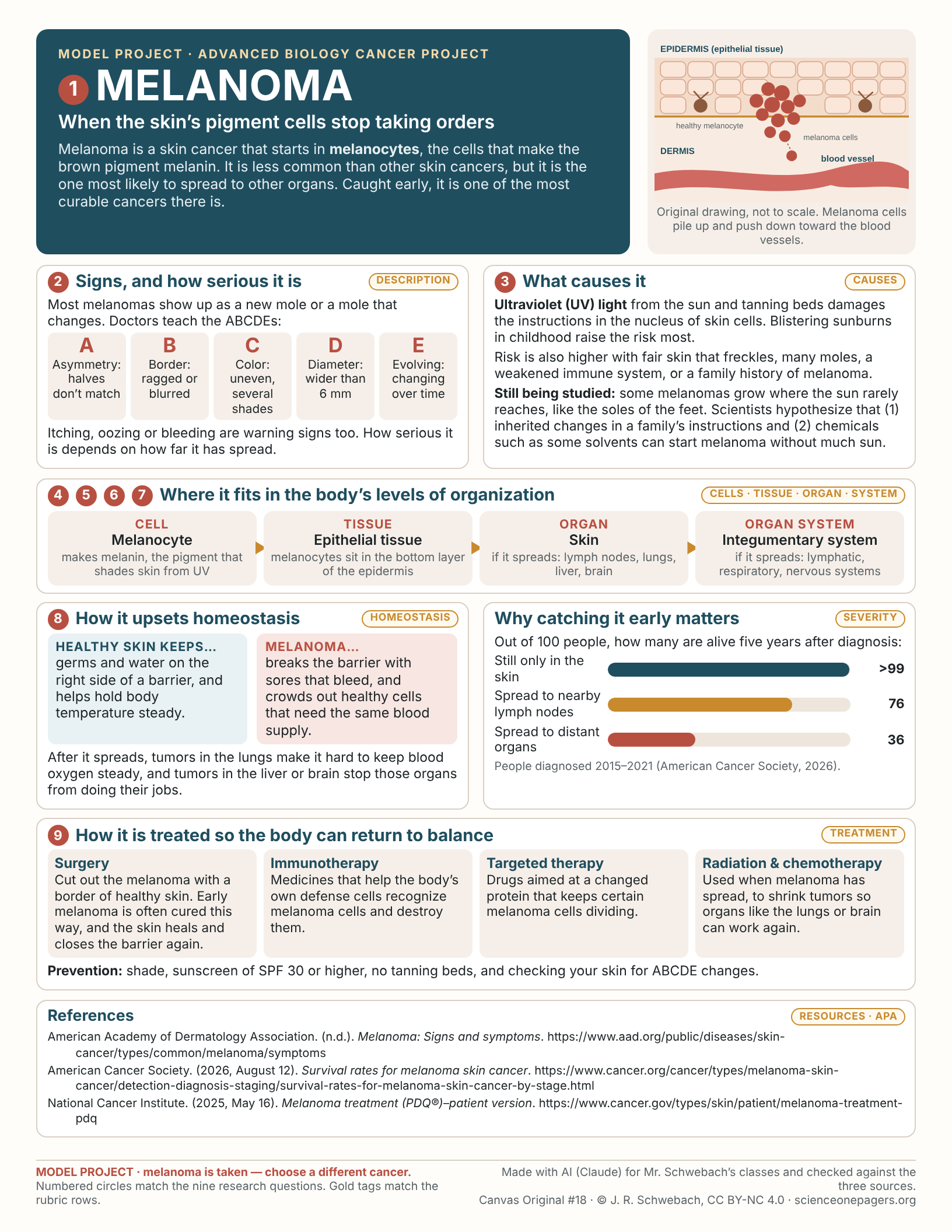
Printable PDF: co-18-melanoma-model.pdf. Sources on the page: American Academy of Dermatology Association, melanoma signs and symptoms; American Cancer Society, survival rates for melanoma by stage (revised August 12, 2026); National Cancer Institute, melanoma treatment PDQ, patient version (updated May 16, 2025).
Canvas Original #19 · Biology #16, Why Elephants Rarely Die of Cancer
Published 4 October 2026 · Advanced Biology I cancer project and Module 2, LT 2.3 · CER one-pager with its own page
Peto’s paradox through the 2015 elephant study: twenty copies of the p53 guard gene, white blood cells that self-destruct twice as readily as ours after damage, and why losing a cell keeps a tissue healthy.
Full page: Biology #16 · Why Elephants Rarely Die of Cancer: Cells That Know When to Quit.
Canvas Original #20 · Teaching #20 and Bio Tool #20, the Semester Paper Guide and the Paper Idea Form
Published 4 October 2026 · DE Biology 101, the semester paper (Battlefield Canvas module “The Biology Paper · Semester 1”) · student guide and interactive form, each with its own page
How a DE Biology student takes a paper from a first interest to a publication-ready manuscript: a researchable question, ten Google Scholar sources in Vancouver style, figures and legends that carry the argument, a future-research section, and Copilot used to question and tighten, never to write.
Full pages: Teaching #20 · Writing a Science Paper in DE Biology: From a First Question to Battlefield Science and Bio Tool #20 · The Paper Idea Form: Your Question, Your Sources, Your Plan.
Canvas Original #21 · Three Kinds of Cells: Card Sort, Practice Check and Exit Slip
Published 5 October 2026 · Biology I and Advanced Biology I, Module 2, Lesson 4 · printed card sort (16 structure cards, 16 job cards, 6 group headers, 2 challenge cards), a 10-question Canvas practice check and a 3-item exit slip
Students sort sixteen cell structures into the groups that hold them, prokaryotes, animal cells and plant cells, match each structure to its job, then check what they know about organelles and specialized cells.
Card sort, round 1. Lay out the six teal header cards. Put each structure card under the one header that describes every kind of cell it is found in.
- In all three cells (prokaryote, animal and plant)
- Prokaryotes only (bacteria)
- Animal and plant cells (eukaryotes only)
- Prokaryotes and plant cells (not animal cells)
- Animal cells only
- Plant cells only
Structure cards. Cell membrane · Ribosomes · Cytoplasm · DNA · Nucleoid region · Nucleus · Mitochondria · Endoplasmic reticulum (ER) · Golgi apparatus · Vesicles · Cytoskeleton · Cell wall · Lysosomes · Centrioles · Chloroplasts · Large central vacuole
Card sort, round 2: job cards. Lay one job card on each structure.
- Controls what goes into and out of the cell.
- Build proteins by following the instructions in DNA.
- Jelly-like fluid that fills the cell. Everything else sits in it.
- The instructions for building and running the cell.
- The area where a bacterium's DNA sits, with no membrane around it.
- Holds the DNA inside a double membrane. The control center.
- Release the energy stored in food and store it as ATP.
- Folded membranes that assemble proteins and lipids and move them through the cell.
- Packages proteins and ships them where they are needed.
- Small membrane sacs that carry materials from place to place.
- Fibers that hold the cell in shape and move things inside it.
- Stiff layer outside the membrane that supports and protects the cell.
- Break down waste and worn-out cell parts.
- Help pull the chromosomes apart when an animal cell divides.
- Capture sunlight and use its energy to make sugar.
- Stores water and pushes outward to keep the plant cell firm.
Challenge cards.
- One possible group has no cards: PROKARYOTES AND ANIMAL CELLS. Explain why nothing belongs there.
- A mushroom cell has a nucleus and a cell wall, but no chloroplasts. Prokaryote or eukaryote? Which header card does it prove wrong?
Practice check, multiple choice, unlimited tries.
- Which structure is found in EVERY cell, prokaryote or eukaryote?
- A nucleus
- Mitochondria
- Ribosomes
- Chloroplasts
- A cell has a cell wall, ribosomes, and DNA loose in the cytoplasm. It has no nucleus. What kind of cell is it?
- A plant cell
- An animal cell
- A prokaryote, such as a bacterium
- A mushroom cell
- A cell has a nucleus, chloroplasts, a cell wall, and a large central vacuole. What kind of cell is it?
- A plant cell
- An animal cell
- A prokaryote
- A neuron
- According to our organelle chart, which structure is in an animal cell but NOT a plant cell?
- Centrioles
- Cell wall
- Chloroplasts
- Large central vacuole
- Which organelle releases the energy stored in food and stores it as ATP?
- Golgi apparatus
- Mitochondria
- Ribosomes
- Cell membrane
- Which organelle packages proteins and ships them to where they are needed?
- Nucleus
- Lysosome
- Golgi apparatus
- Cell wall
- Which statement about prokaryotes is TRUE?
- They have a nucleus but no ribosomes.
- They have no membrane-bound organelles.
- They are always multicellular.
- They are larger than eukaryotic cells.
- Mystery Cell Model B, the intestine cell, is covered in microvilli. How do microvilli help it do its job?
- They add surface area, so the cell can absorb more nutrients.
- They use sunlight to make sugar.
- They carry electrical signals to muscles.
- They sweep mucus out of the airway.
- Mystery Cell Model D, the neuron, has one long axon. What does the axon do?
- It stores water and nutrients.
- It carries electrical signals out to other cells.
- It builds proteins.
- It protects the cell from injury.
- Mystery Cell Model E, the root hair cell, is a plant cell, but it has no chloroplasts. Which explanation fits best?
- Plant cells never have chloroplasts.
- Root cells grow underground in the dark, so their job is taking in water and minerals, not making sugar.
- Chloroplasts are only found in prokaryotes.
- The cell wall does the job of the chloroplasts.
Exit slip.
- Circle the ONE structure that every cell has: nucleus · ribosomes · chloroplasts · mitochondria
- A cell has a cell wall, chloroplasts and a nucleus. Circle: prokaryote · animal cell · plant cell
- My Mystery Cell was a ______________ cell. One special part it has is the ______________, and it helps the cell ______________________________.
Canvas Original #22 · Module 2 Word Cards: Five Decks Built From the Crosswords
Published 6 October 2026 · Biology I and Advanced Biology I, Module 2 Cell Structure and Function, additional resource · cut-out card set, five decks, 100 words and 100 meanings, with a small-group routine
The words from Bio Tool #21, the Module 2 crosswords, on cards students cut apart and play at tables of three or four, plus ten new words that help on the Virginia SOL and a fifth deck that ties the cell back to the molecular core of Module 1.
Four rounds. Match each word to its meaning, reading every word aloud; sort the pairs into piles and name each pile with a reason; say a word without saying it; join two words in one true sentence and check it against the meanings.
The five decks (★ marks a word not yet used in the Module 2 lessons):
- D1 · Cell Theory and Two Kinds of Cells (LT 2.1, 2.2, 22 cards): hypothesis · theory · law · tenet · microscope · technology · evidence · observation · prediction · cell division · metabolism · hereditary information · prokaryote · eukaryote · bacteria · organelle · cytoplasm · cell wall · chloroplast · vacuole · centrioles · flagella
- D2 · Organelles at Work, Levels and Homeostasis (LT 2.2, 2.3, 24 cards): nucleus · ribosome · rough ER · Golgi apparatus · vesicle · lysosome · mitochondria · cytoskeleton · protein · ATP · insulin · interdependent ★ · unicellular · multicellular · specialized · tissue · organ system · organism · homeostasis · stomata · guard cells ★ · heart rate · sweat · roots
- D3 · The Cell Membrane (LT 2.4, 16 cards): cell membrane · phospholipid · phospholipid bilayer · hydrophilic · hydrophobic · cholesterol · integral protein · peripheral protein · channel protein · transport protein · aquaporin ★ · receptor ★ · glycoprotein ★ · carbohydrate chains · fluid mosaic model · selectively permeable
- D4 · Transport and Tonicity (LT 2.5, 23 cards): diffusion · osmosis · facilitated diffusion · passive transport · concentration · concentration gradient · equilibrium · solute · solvent · rate of diffusion · hypertonic · hypotonic · isotonic · burst · plasmolysis ★ · turgor pressure ★ · contractile vacuole ★ · active transport · protein pump · endocytosis · exocytosis · phagocytosis · pinocytosis
- D5 · Bridges Back: Cells and the Molecular Core (Spiral: Units 1, 3, 4 and 9, 15 cards): polar · hydrogen bond · monomer · polymer · amino acid · nucleotide · nucleic acid · lipid · glucose · enzyme · chlorophyll · photosynthesis · cellular respiration ★ · DNA · virus ★
Printable PDF, eleven pages (a cover with the routine, then each deck's words and meanings): co-22-module-2-word-cards.pdf.